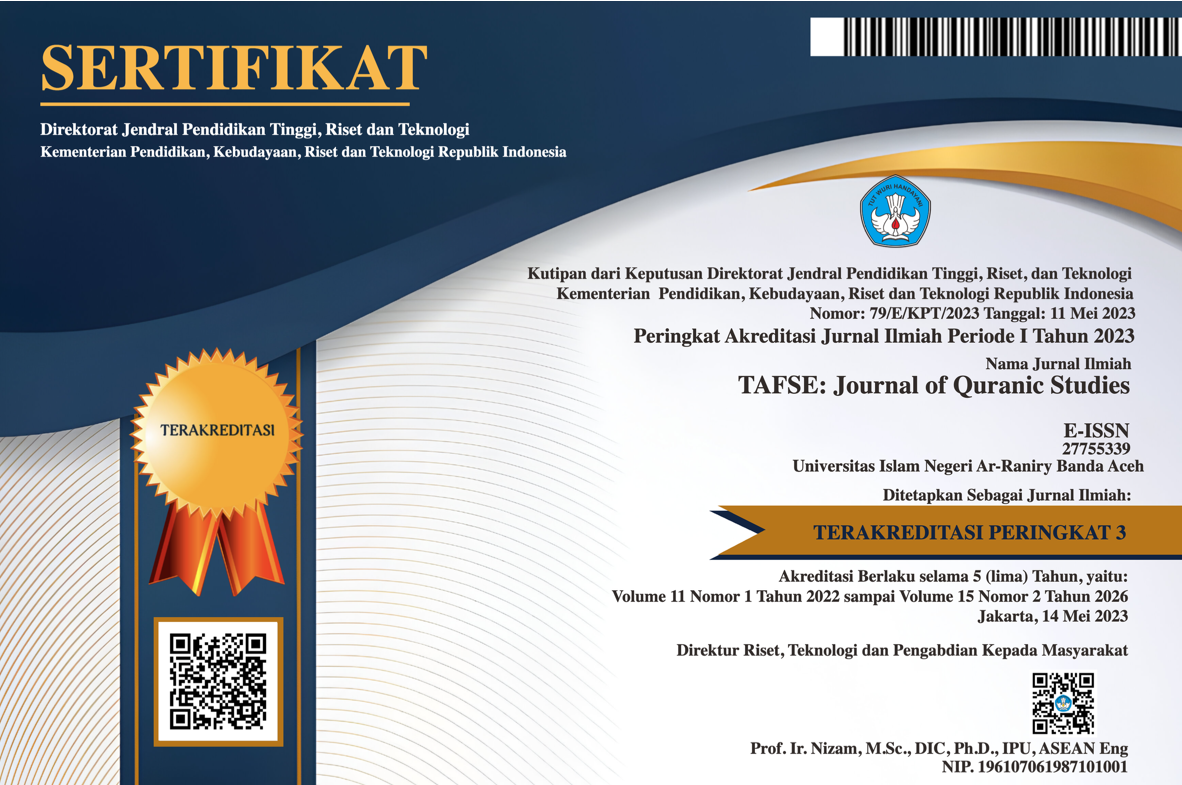
ACCREDITATION
TEMPLATE

TOOL & REFERENCES


VISITORS

TAFSE: Journal of Qur’anic Studies is a peer-reviewed, open-access scholarly journal dedicated to original research in Qur’anic studies and tafsir. It seeks to advance critical scholarship on the Qur’an by publishing research that makes a clear intellectual contribution, engages relevant primary texts and scholarship, and explains its analytical approach transparently.
The journal provides a forum for researchers working across classical and contemporary Qur’anic interpretation. It welcomes research from Indonesia and beyond, while maintaining the same editorial and ethical criteria regardless of the authors’ institutional or geographic affiliation.
Manuscripts must engage directly and substantively with the Qur’an, Qur’anic interpretation, or a closely related scholarly question. The journal’s established scope encompasses:
The scope is intended to facilitate sound interdisciplinary inquiry, not to accept unrelated studies merely because they mention Islamic values or quote Qur’anic verses.
Submissions should articulate a clear research question or objective, position the work in relation to relevant research, explain the sources and method used, present an evidence-based analysis, and identify the contribution of the findings. Claims of novelty should be proportionate to the evidence and should not depend solely on a new geographical setting or a different set of verses.
Interpretive analyses should distinguish the Qur’anic text, the arguments of cited exegetes, and the author’s own reading. Empirical research, including living Qur’an studies, should describe sampling, data collection, analysis, and ethical safeguards as applicable.
TAFSE principally publishes original research articles. The manuscript must not have been published previously or submitted simultaneously to another journal. Relevant overlap with earlier publications, preprints, theses, or conference presentations must be disclosed to the editor.
Manuscripts outside the journal’s core scope, predominantly descriptive writing without a research argument, unsupported interpretations, and work that does not meet the journal’s scholarly or ethical requirements may be declined at editorial screening. Publication is not guaranteed by compliance with formatting requirements.
