ACCREDITATION
TEMPLATE

TOOL & REFERENCES


VISITORS

TAFSE · Journal of Qur'anic Studies
Editorial standards, author requirements, peer review, publication ethics, copyright, open access, and journal management.
Select a policy to view its full text. All journal policies are publicly accessible in this directory.
TAFSE: Journal of Qur’anic Studies is an open-access, peer-reviewed academic journal dedicated to original scholarship on the Qur’an and its interpretation. Published by the Al-Qur’an and Tafsir Study Program, Faculty of Ushuluddin and Philosophy, Universitas Islam Negeri Ar-Raniry, Banda Aceh, the journal advances rigorous study of Qur’anic texts, exegetical traditions, and their intellectual and social contexts.
TAFSE provides an academic forum for original contributions to Qur’anic studies, strengthens methodological and theoretical debate in tafsir scholarship, and supports the dissemination of well-substantiated findings to researchers and wider scholarly communities.
Submissions must address a clear research problem, engage relevant primary sources and scholarship, describe the method of inquiry, and develop an evidence-based argument. Interdisciplinary manuscripts must demonstrate a substantive relationship to the Qur’an or tafsir. The journal publishes original research articles that have not been published previously or submitted simultaneously elsewhere.
Editorial assessment is based on relevance, originality, methodological adequacy, analytical coherence, scholarly contribution, and compliance with publication ethics. TAFSE welcomes submissions from researchers of diverse institutional and geographic backgrounds.
TAFSE accepts original research articles that contribute to Qur’anic studies and tafsir. Eligible articles may employ textual analysis, library-based research, historical inquiry, comparative interpretation, empirical fieldwork, living Qur’an approaches, or other appropriate qualitative and interdisciplinary methodologies.
Every submission must present a defined research question or objective, a relevant scholarly context, a transparent method, a substantive analysis of evidence, and a conclusion supported by the findings. Literature-based articles must offer an original analytical contribution rather than merely summarize existing writings.
Book reviews, opinion pieces, conference reports, and non-research submissions are outside the journal’s regular article category unless a dedicated section is announced by the editorial office. All research articles undergo editorial screening and peer review according to journal policy.
TAFSE publishes two issues each year, in June and December. Articles are published according to the journal’s issue schedule following successful peer review, editorial acceptance, and completion of publication production.
The dates of submission, acceptance, and publication are recorded in article metadata. The editorial office informs authors about material delays or changes to an accepted manuscript’s publication schedule. Publication is contingent on academic quality, ethical compliance, and completion of the editorial process.
The current and previous issues are accessible through the journal’s issue archive.
TAFSE provides electronic access to published articles through its Open Journal Systems (OJS) platform. The journal’s archive of volumes and issues contains publication records, article metadata, and available full-text files. Published articles receive persistent DOI identifiers using the journal’s DOI prefix 10.22373 where assigned.
Published article records and full-text files form part of the journal’s electronic archive. The publisher is responsible for maintaining access to the journal record and ensuring the continuity of the archive during website maintenance, technical migration, or changes to the publishing platform. Article metadata, citation details, and the record of subsequent corrections or retractions remain associated with published works.
Authors may deposit their published articles in institutional repositories, disciplinary repositories, or personal academic websites, provided that the original TAFSE publication is acknowledged, the DOI is included where available, and reuse complies with the license attached to the article.
Authors retain copyright in their original scholarly work and grant TAFSE: Journal of Qur’anic Studies the right of first publication. The author’s copyright is distinct from the journal’s rights in its website, journal branding, and compilation or presentation of editorial material.
Authors may enter non-exclusive arrangements for the distribution of their work, including deposit in an institutional repository, inclusion in a book, or dissemination on a personal academic website, with acknowledgement of first publication in TAFSE and compliance with the applicable Creative Commons license.
Authors are responsible for obtaining required permissions for copyrighted illustrations, photographs, tables, translations, manuscript reproductions, and other third-party material included in an article. Copyright ownership and licensing terms are stated in the published article and its associated metadata.
TAFSE publishes scholarly articles under the Creative Commons Attribution-NonCommercial 4.0 International (CC BY-NC 4.0) license. Under this license, readers may share and adapt published material for non-commercial purposes, provided that appropriate attribution is given, the original publication is identified, the license is linked, and any changes are indicated.
The license does not authorize use that exceeds its terms or override third-party rights, privacy rights, or permissions associated with particular content. For complete license terms, consult Creative Commons CC BY-NC 4.0.
Authors retain copyright and grant TAFSE the right of first publication. The license specified on each published article governs that work; earlier publications retain the licenses under which they were originally released.
TAFSE requires original work that accurately acknowledges all quotations, paraphrases, ideas, data, images, translations, and previously published interpretations. Plagiarism, unattributed reproduction of source material, fabricated citations, citation manipulation, redundant publication, and simultaneous submission to multiple journals are prohibited.
Submitted manuscripts are screened for textual similarity using Turnitin during editorial assessment. Similarity reports assist the detection of potentially unattributed text or overlapping material; similarity percentages alone do not constitute proof of plagiarism. Editors examine the sources, citations, context, and significance of any overlap before deciding the appropriate action.
Minor problems of attribution or quotation may be returned to authors for correction. Serious plagiarism, duplicate publication, intentional misrepresentation, or material fabrication may lead to rejection or investigation under the journal’s research misconduct policy. Where a serious issue is established after publication, the journal may publish a correction, expression of concern, or retraction as warranted.
Authors must disclose related preprints, theses, conference papers, repository versions, and other publications that share substantial content with the submitted manuscript.
TAFSE investigates credible allegations of research and publication misconduct in accordance with principles of fairness, confidentiality, proportionality, and the integrity of the scholarly record. Misconduct includes fabrication or falsification of data, manipulated evidence, plagiarism, citation manipulation, authorship misrepresentation, unethical treatment of participants, interference with peer review, and deliberate concealment of relevant conflicts of interest.
Authors, reviewers, readers, institutions, and other concerned parties may report a suspected breach through the journal’s official contact page. Reports should identify the manuscript or article, describe the concern, and provide verifiable supporting information when available. Reports are handled discreetly and assessed without prejudging the individuals involved.
Research involving interviews, observations, focus groups, surveys, or identifiable personal information must comply with relevant legal and institutional ethical requirements. Manuscripts must describe research approval or an applicable exemption, informed-consent procedures, and measures used to safeguard participants. Extra precautions are required when studies involve children or vulnerable communities. Permission to participate in research does not automatically authorize public identification of participants.
Allegations concerning published work are managed in accordance with the journal’s Corrections and Retractions policy and relevant guidance from the Committee on Publication Ethics (COPE).
All participants in the publication process must disclose any relationship or interest that could reasonably be perceived as affecting impartiality. Competing interests may be financial, institutional, professional, academic, personal, or ideological.
Authors must declare research funding, relevant financial support, institutional affiliations, and competing interests in the manuscript or submission declarations. Where no competing interests exist, this should be stated explicitly. The role of funders in the design, conduct, analysis, and publication of the study must be disclosed where relevant.
Editors and reviewers must disclose relevant competing interests before accepting a manuscript assignment. Reviewers with an unmanaged conflict must decline the invitation. A manuscript involving an editor, a close collaborator, or a relevant institutional or personal relationship must be assigned to an independent handling editor.
Disclosure of a competing interest does not automatically preclude publication. The editorial office evaluates its nature and significance and applies appropriate safeguards to preserve independent assessment.
TAFSE welcomes evidence-based scholarly discussion of its published articles, including reasoned criticism, clarifications, methodological questions, and reports of possible errors. Such correspondence contributes to the reliability and continuing assessment of published research.
Correspondence may be submitted through the journal’s official contact page. Contributors should identify the relevant article, its DOI where available, and the specific issue being raised, and should provide supporting evidence or references.
The handling editor assesses the scholarly relevance, evidence, language, privacy implications, and any competing interests associated with the submission. The editor may invite the article’s authors to respond, consult independent experts, or publish a scholarly reply or editorial notice. Material errors and concerns about research integrity are handled under the journal’s correction and retraction procedures.
Post-publication discussion must remain professional, constructive, and grounded in verifiable evidence. Personal attacks, unsubstantiated accusations, and disclosure of confidential information are not acceptable.
TAFSE maintains the integrity of published scholarship through transparent correction of errors and proportionate editorial action when concerns arise. The journal follows the principles of the COPE Retraction Guidelines (2025).
A correction is issued when an identifiable error materially affects the accuracy or interpretation of an article but does not invalidate its central findings. A correction notice identifies the original article, explains the correction, and is made openly accessible.
An expression of concern may be issued when serious questions about the reliability or ethics of an article remain unresolved and readers need to be informed while an investigation proceeds.
An article may be retracted when its central findings cannot be relied upon because of major error, fabrication, falsification, plagiarism, redundant publication, compromised peer review, unauthorized use of materials, or other serious misconduct. Retraction protects the scholarly record; it is not a disciplinary penalty against an individual.
Correction, expression-of-concern, and retraction notices are clearly identified, dated, freely available, and linked to the affected article. The article’s bibliographic record is retained with an explicit indication of its status. Full-text removal is reserved for exceptional circumstances involving legal obligations, serious privacy breaches, or significant safety risks, with an explanatory public record as appropriate.
Authors are expected to notify the editorial office promptly if they discover a significant error in their published work and to cooperate in its resolution.
TAFSE uses double-blind peer review, in which author and reviewer identities are concealed during normal manuscript evaluation. Editorial decisions are based on scholarly merit, the journal’s scope, methodological adequacy, the quality of evidence, publication ethics, and independent reviewer assessments.
Assessment covers originality of contribution, theoretical and methodological soundness, analytical coherence, accurate handling of Qur’anic texts and tafsir sources, appropriate citations, and the ability to communicate findings clearly. The normal screening and evaluation period is approximately three to four months from receipt, subject to manuscript complexity, reviewer availability, and revision requirements.
Editors and reviewers must preserve the confidentiality of submitted work, disclose competing interests, and provide professional, evidence-based assessments. Editorial decisions are independent of APC payments or commercial considerations. Authors may request reconsideration of a decision by providing specific evidence of a procedural error or material factual misunderstanding through the official journal contact channel.
A request for revision does not guarantee acceptance; the final publication decision rests with the journal’s authorized editors.
TAFSE provides immediate open access to its published articles. Readers may view, read, download, and share articles without subscription or pay-per-view charges. The absence of access fees for readers is distinct from the article processing charge applicable to authors of accepted manuscripts.
Reuse of published work is governed by the Licensing Policy, which provides for publication under the Creative Commons Attribution-NonCommercial 4.0 International license. Authors retain copyright and grant the journal the right of first publication.
TAFSE: Journal of Qur’anic Studies is published by the Program Studi Ilmu Al-Qur’an dan Tafsir, Fakultas Ushuluddin dan Filsafat, Universitas Islam Negeri Ar-Raniry, Banda Aceh, Indonesia. The journal collaborates with the Asosiasi Ilmu Al-Qur’an dan Tafsir se-Indonesia (Decree No. 01/JT/03/2022).
The Editor-in-Chief is Prof. Dr. Salman Abdul Muthalib, Lc., M.Ag., and the Managing Editor is Zulihafnani, S.Th.I., M.A.. The full editorial structure and institutional affiliations are published on the Editorial Team page.
The editorial team manages scholarly assessment, peer review, publication decisions, and ethical oversight. The publisher provides institutional support while respecting the independence of editorial decisions.
Journal identifiers: P-ISSN 2620-4185; E-ISSN 2775-5339; DOI prefix 10.22373. The journal was first published in 2017.
Editorial Office — TAFSE: Journal of Qur’anic Studies
Program Studi Ilmu Al-Qur’an dan Tafsir
Fakultas Ushuluddin dan Filsafat
Universitas Islam Negeri Ar-Raniry
Jl. Syeikh Abdul Rauf, Kopelma Darussalam
Banda Aceh 23111, Aceh, Indonesia
For manuscript submissions, author queries, research-integrity allegations, complaints, appeals, and post-publication correspondence, contact the editorial office through the journal’s Contact Information page. Manuscript status and editorial correspondence are managed through the journal’s OJS submission system.
TAFSE provides article-level usage statistics through the journal’s online publication pages. Article records display readership activity, including article views and full-text downloads, alongside publication metadata and DOI information.
Readers may consult the current issue and issue archive to access article-level usage data. View and download counts describe the use of journal content and are distinct from citation totals and indexing records.
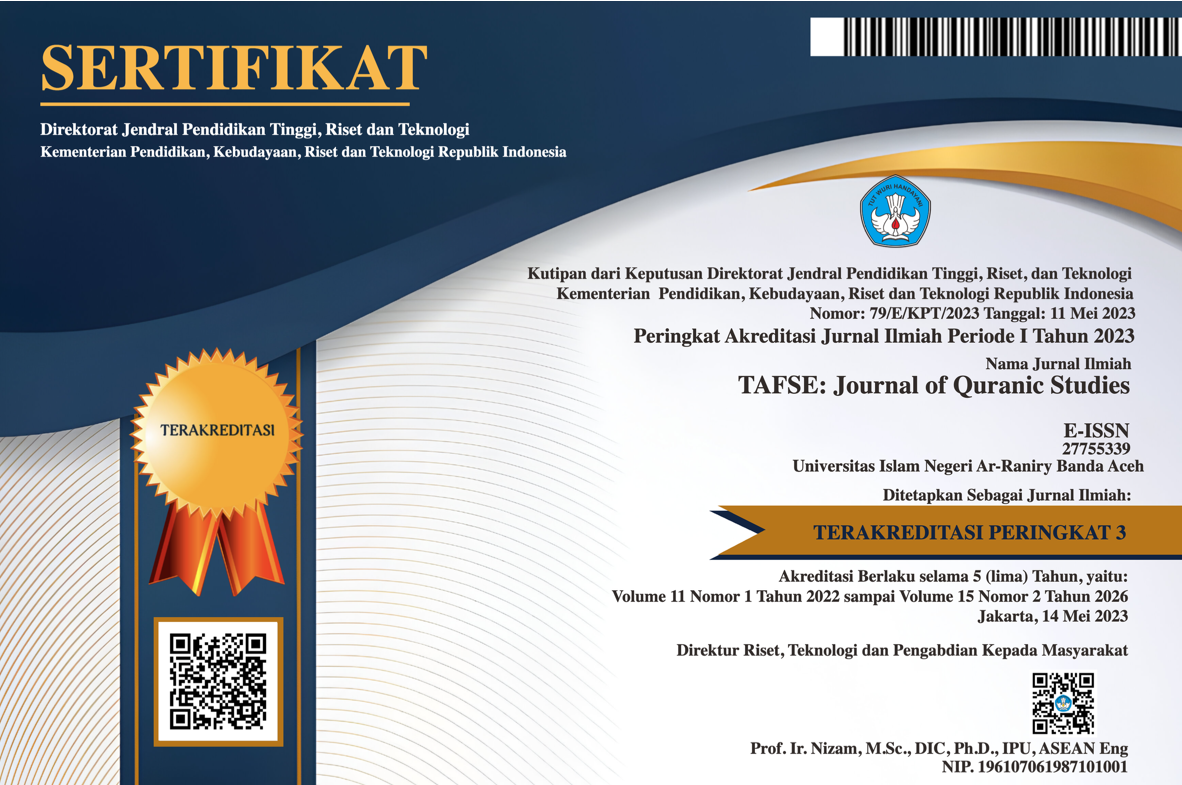
TAFSE: Journal of Qur’anic Studies is accredited SINTA 3 under Decree No. 79/E/KPT/2023 of 11 May 2023. The journal’s scholarly articles are discoverable through national and academic indexing and discovery services.
Published articles carry bibliographic metadata and DOI links using the journal’s prefix 10.22373, supporting citation and retrieval of the original publication.
TAFSE: Journal of Qur'anic Studies recognizes that generative artificial intelligence (AI), including large language models, AI-powered writing assistants, translation systems, image generators, and research-support tools, may assist scholarly work. Their use must not compromise originality, academic judgment, research integrity, confidentiality, attribution, or accountability. This policy applies to authors, reviewers, editors, and editorial production personnel throughout submission, evaluation, revision, and publication.
Only human contributors who meet the journal's authorship criteria may be named as authors. An AI tool must not be listed as an author or co-author because it cannot approve a manuscript, take responsibility for its content, disclose competing interests, or answer questions about the integrity of the work. Human authors remain fully responsible for the accuracy, originality, interpretation, citations, permissions, and ethical compliance of all submitted material, including AI-assisted content.
Generative AI may be used as an auxiliary tool for language refinement, grammar and readability improvements, translation assistance, formatting suggestions, organization of an author-prepared draft, and other clearly defined support tasks. Its output must be critically checked and substantively controlled by the authors. Ordinary non-generative spelling, reference-formatting, and word-processing functions do not require an AI-use declaration unless they generate substantive content.
If AI is used for research-related tasks such as coding, categorizing, translating or analyzing data, generating figures, or assisting computational procedures, the Methods section must explain the tool, its role, relevant procedures, validation steps, and how the work can be scrutinized or reproduced, insofar as permitted by confidentiality and research ethics.
The following practices are prohibited:
Authors must disclose substantive use of generative AI when submitting a manuscript, including the tool or service name, its version or model when identifiable, the purpose of use, and the specific tasks or manuscript sections affected. The disclosure should appear in the cover letter or submission declarations and in a clearly identified Declaration of Generative AI Use before the references or in the acknowledgments, as appropriate. Research-related AI use must also be reported in the Methods section. Authors may be asked to provide further documentation when necessary for editorial assessment.
Where no generative AI was used, authors may state: “The authors did not use generative AI tools in preparing this manuscript.” A declaration must accurately reflect the actual work and must not be used to conceal material assistance.
AI-generated text and suggestions are not scholarly evidence in themselves. Authors must verify every quoted passage, verse reference, tafsir attribution, hadith citation, Arabic transliteration, translation, and reference entry using authoritative original sources. Quotations and bibliographic metadata must be checked against the cited publications; a generated citation must never substitute for reading and evaluating the underlying source. Authors remain responsible for distinguishing primary evidence from interpretation and for avoiding distortions of religious texts or research findings.
Authors must not enter identifiable participant information, confidential interview material, restricted archival content, unpublished third-party work, or other protected data into an external AI service unless the intended processing is authorized, its data-handling safeguards have been evaluated, and all necessary permissions and ethical conditions are met. AI-assisted production does not remove the obligation to respect copyright, licensing terms, consent requirements, or the rights of third parties.
Submitted manuscripts, review reports, and editorial correspondence are confidential. Reviewers and editors must not upload these materials, in full or in part, to external AI systems where confidentiality cannot be assured without the author's explicit permission and the journal's authorization. Reviewers must obtain permission from the editorial office before using AI to assist with peer review and must disclose any authorized use. Editorial decisions and peer-review judgments must remain under accountable human control; AI-generated assessments alone cannot determine acceptance or rejection.
If the journal uses AI-assisted tools for substantive copyediting, production, or editorial communication, the relevant use should be disclosed to affected authors, with human verification and suitable privacy safeguards.
Editors may request clarification about undisclosed AI use, inspect source material, and evaluate the reliability of claims, evidence, and references. Automated AI-detection scores are not conclusive evidence of misconduct and must not be the sole ground for rejecting a manuscript or imposing a sanction. Where concerns arise, the journal follows a fair, evidence-based procedure, giving authors an opportunity to respond. Outcomes may include clarification, revision, rejection, correction, an expression of concern, or retraction, depending on the facts and their impact on the scholarly record.
This policy is guided by the publication-ethics principles of the Committee on Publication Ethics (COPE), the ICMJE Recommendations on artificial intelligence in scholarly publishing, and the World Association of Medical Editors (WAME) recommendations on generative AI and manuscripts.
TAFSE: Journal of Qur’anic Studies · Universitas Islam Negeri Ar-Raniry, Banda Aceh, Indonesia.
