About
Policies
Article Template


Journal Details


Frequency: Biannual (January–June & July–December)
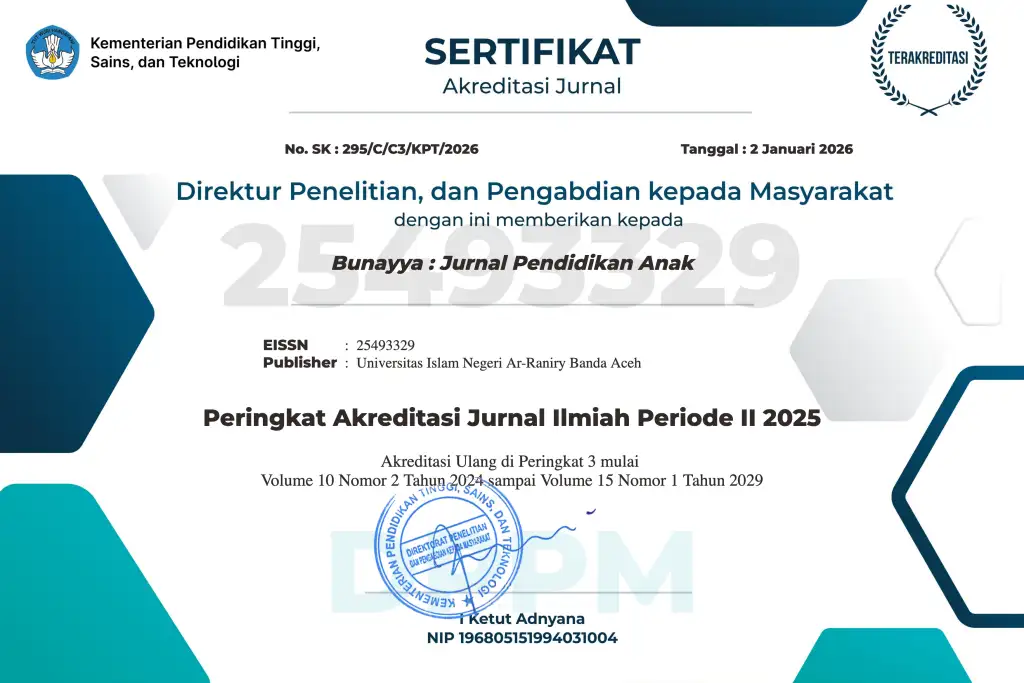
Publisher: Program Studi Pendidikan Islam Anak Usia Dini (PIAUD) Fakultas Tarbiyah dan Keguruan (FTK) UIN Ar-Raniry Banda Aceh

Bunayya: Jurnal Pendidikan Anak is a peer-reviewed journal published by Program Studi Pendidikan Islam Anak Usia Dini (PIAUD) Fakultas Tarbiyah dan Keguruan (FTK) UIN Ar-Raniry Banda Aceh. It publishes research and analysis on early childhood education twice a year, in January–June and July–December.
The journal serves as a scholarly medium for lecturers, researchers, practitioners, teachers, students, and the general public who are concerned with early childhood education and learning. It publishes research and analysis related to the development of moral and religious values, physical-motor, social-emotional, cognitive, and language development, artistic and creative development, special needs, parenting, management of early childhood institutions, assessment, instructional media, learning strategies, and innovation in early childhood education. See Aim and Scope and Types of Manuscripts.
All manuscripts undergo double-blind peer review by two reviewers. See the Peer Review Process Policy and the Reviewer Guidelines.
The journal follows the COPE guidelines for publication ethics. See Publication Ethics, Plagiarism Policy, and Allegation of Research Misconduct.
All articles are free to read, download, and share under the CC BY-SA 4.0 licence. See Access and Licensing.
The journal's content is preserved through LOCKSS, CLOCKSS, and the PKP Preservation Network. See Electronic Archiving.
Raising successful children is not solely the responsibility of formal educational institutions—it can and should begin within the family from an early age. One of the key factors in nurturing quality children lies in maximizing the golden opportunity, known in the study of human growth and development as The Golden Age.
Numerous studies have shown that this golden period begins at conception, when the child is still in the womb, and continues through the early years after birth—referred to as early childhood. Research on the Golden Age highlights its crucial role in determining the quality of human life. It is a highly effective and critical period for optimizing a child’s various intellectual, emotional, and spiritual potentials in the pursuit of producing high-quality human resources.
Success in developing a child’s intellectual, emotional, and spiritual intelligence is closely linked to the awareness and engagement of parents in utilizing this golden window of opportunity. The consistent and continuous involvement of parents in nurturing and supporting the growth and development of their children during this phase greatly influences the child’s future quality.
Parenting during this time requires not only care and education, but also adequate nutritional support for intellectual development, as well as "non-intellectual" nourishment that fosters emotional and spiritual growth. This is achieved through consistent and continuous care, education, and discipline, particularly in the internalization and socialization of religious, moral, social, and cultural values throughout the Golden Age.
It is with this awareness that Bunayya: Jurnal Pendidikan Anak was established. It is our hope that Bunayya: Jurnal Pendidikan Anak will serve as one of the answers to the many challenges related to early childhood education and development.
Frequency: Biannual (January–June & July–December)
Publisher: Program Studi Pendidikan Islam Anak Usia Dini (PIAUD) Fakultas Tarbiyah dan Keguruan (FTK) UIN Ar-Raniry Banda Aceh
Registered authors and reviewers, sign in to submit manuscripts or complete reviews.
Login
Program Studi Pendidikan Islam Anak Usia Dini (PIAUD),
Fakultas Tarbiyah dan Keguruan (FTK),
UIN Ar-Raniry Banda Aceh
Content is available under the Creative Commons Attribution-ShareAlike 4.0 International License.

Jln. Syekh Abdul Rauf No. 1, Darussalam
Banda Aceh 23111, Aceh, Indonesia
E-mail: bunayya@ar-raniry.ac.id